Posts

Showing posts with the label Grammar

Grammar: the accuracy of calling its teaching an art Grammar learning and the implicit comprehension of language patterns

Image
  https://eltnews.gr/post/grammar-the-accuracy-of-calling-its-teaching-an-art/ Considering one of the definitions of art as “the process of making the familiar unfamiliar”, grammar teaching can justifiably be paralleled to art. Grammar estranges language, it makes it look unfamiliar. For us, teachers, it takes long and intensive training to teach grammar accurately and comprehensively, and we need to instruct grammar in a way that learners want to remain engaged. Learners’ attitudes and responses to the scientific side of language Students respond to grammar defensively: we observe how they silently withdraw and how they reluctantly, or minimally engage to grammar activities. Grammar seems to be the point where language makes no sense. Especially English grammar. Jonathan   Rigdon (1903) voiced the complexity of English grammar early on: “he who can analyse the English sentence is well prepared to analyse anything else”. Also confounding can be the appropriate timing:...
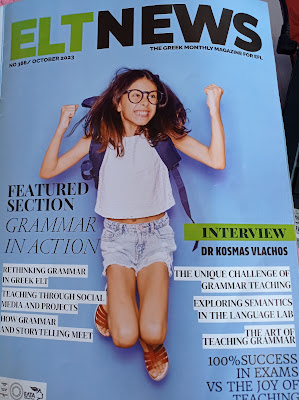
Teaching Grammar: The accuracy of calling its teaching an art

Image
  Grammar: the accuracy of calling its teaching an art Grammar learning and the implicit comprehension of language patterns Considering one of the definitions of art as “the process of making the familiar unfamiliar”, grammar teaching can justifiably be paralleled to art. Grammar estranges language, it makes it look unfamiliar. For us, teachers, it takes long and intensive training to teach grammar accurately and comprehensively, and we need to instruct grammar in a way that learners want to remain engaged.   Learners’ attitudes and responses to the scientific side of language Students respond to grammar defensively: we observe how they silently withdraw and how they reluctantly, or minimally engage to grammar activities. Grammar seems to be the point where language makes no sense. Especially English grammar. Jonathan   Rigdon (1903) voiced the complexity of English grammar early on: “he who can analyse the English sentence is well prepared to analyse anything ...

The Atlantic, Education: The Wrong Way to Teach Grammar

Image
EDUCATION The Wrong Way to Teach Grammar No more diagramming sentences: Students learn more from simply writing and reading. MICHELLE NAVARRE CLEARY FEBRUARY 25, 2014 A century of research shows that traditional grammar lessons—those hours spent diagramming sentences and memorizing parts of speech—don’t help and may even hinder students’ efforts to become better writers. Yes, they need to learn grammar, but the old-fashioned way does not work. This finding—confirmed in 1984, 2007, and 2012 through reviews of over 250 studies—is consistent among students of all ages, from elementary school through college. For example, one well-regarded study followed three groups of students from 9th to 11th grade where one group had traditional rule-bound lessons, a second received an alternative approach to grammar instruction, and a third received no grammar lessons at all, just more literature and creative writing. The result: No significant differences among the three groups—except...