Posts

Showing posts with the label identity

The Celebration of Nativity in Greece Through Time
Image
    🎄🎄🎄🎄🎄🎄🎄 Festivals have been a part of human life since antiquity. Traces of our past Christmas customs and celebrations are found everywhere, from decorations, habits, to culinary creations. The past is diffuse in the Christmas celebrations of today, and it is more than exciting to relive the customs established by our ancestors. Folk spirit is present in many more events and habits of the Nativity than we imagine. The reason why folklore persists through time and space, is because the things people traditionally make with their words, hands, and actions, continue to give pleasure, and satisfy artistic impulses common to the species. Folklore persists also because it continues to meet basic human needs. In the calendar, the period stretching from Christmas Eve to the Epiphany, is the “Twelve Days of Christmas” and it includes most of the Christmas customs. While some Christmas customs came to us from other places, for example Mexico, where from comes the turkey, a...

Umberto Eco 一 «Noi siamo la nostra memoria. Quando morirò, ricorderò tutto»

Image
☆ As humans, when we say "I", we mean our memory  ☆ Memory is selective ☆ Shared memories mean common identity, ☆ Semantic memory is what we know about the world ☆ We are made of time ☆ Without memory, there is no soul  ☆ Fathers die when they stop telling us what they know and begin asking us something new  ☆ The day I'll day I'll remember everything

Remembrance Day for the Thracian Genocide: The Black Easter of 1914

Image
By Marina Siskos. April 6 marks the Remembrance Day for the genocide of Thracian people. For Thrace, Easter of 1914 was the  Black Easter. Implications of injustice, massive destruction and extermination of the Thracians extends to the present as the genocide affects the formation of identity and consciousness of their descendants. Collective memory moulds identity: mentality, discourse, self-perception and all its dimensions, material and non-material culture, literature and mythologies, directly or indirectly refer to the past and the suffering, the need for remembrance and the what should have been. Systematic atrocity: Backdrop of the Genocide of Ottoman minorities The turn of the 19th century heralds the collapse of the “multi-ethnic, multi-religious Ottoman Empire,” manifested among a host of factors, such as the weakening of its once robust army, by the emergence of national independence movements, in tandem with opposing, imperialist European powers (Hoffman, 2022). The mov...

Carnivalesque customs of Thrace: The timeless value of satire practiced through rituals

Image
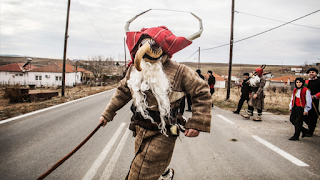
  By: Marina Siskos Published in the Greek Herald  https://greekherald.com.au/culture/history/carnivalesque-customs-of-thrace-the-timeless-value-of-satire-practiced-through-rituals/?fbclid=IwAR383O4Bg0MzPE2Pm8_FHXAupa8cPpwKjAE8PHhNAUiAAHw3k8mFNlyKDhw Carnival customs are observed on the first Sunday of Christian Orthodox fasting, The Tyrian Sunday, alongside most significant Thracian customs Thrace is Dionysus’s birthplace. Dionysus, or Bacchus, was the god of the grape-harvesting, winemaking, vegetation and fertility. Dionysus was the son of Semeli and Zeus (Moutsopoulos, 2016). Thracian festivities celebrated to this day are sharply reminiscent of Dionysus’s characteristic shenanigans (Moutsopoulos, 2016). The customs known as  Kopek   Mpehis  and the  Monks , as described in narrative skillfulness by the master of  ethnographia , Georges Vizeynos, date back to the antiquity. Representations of the carnivalesque customs and practiced are preserved wi...