Posts

Showing posts with the label community

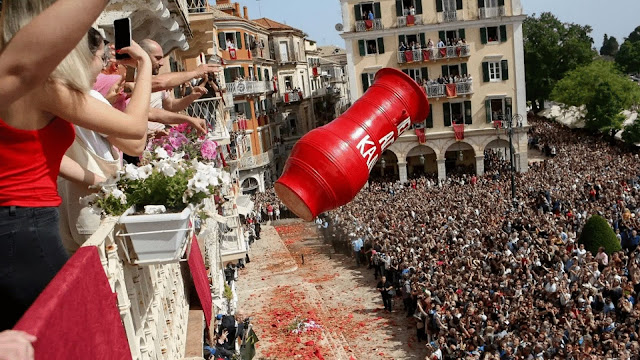
Greek Easter: Holy celebration of life over death around Greece
Image
  By Marina Siskos Orthodox Easter evokes the closest feeling to holiness. Greek Easter (Pascha) heralds the arrival of spring, hope and the atmosphere around Greece is replete with a rejuvenated sense of joy, community and of course, festivity, celebrating the eternal victory of life over death, through experiencing death itself, just as reverberated in the Resurrection hymn: “ thanato, thanaton patisas ” ( θανάτω, θάνατον πατήσας ). Originally, Easter apparently was regarded as commemorating the Crucifixion, but the interpretation was shifted quite early to the Resurrection (Barnett, 1949). The Holy Week (Megali Evdomada) or the Week of Pathoi (the series of the sufferings and sorrows, representing the days prior to Christ’s crucifixion by the Romans in 30 A.D.) is the week prior to the Holy Easter, starting from Palm Sunday (Kyriaki ton Vayon) up to the Holy Saturday. It marks the final week of Lent, the forty-day period of fasting, prayer and penitence, and of which each day is...


Carnivalesque customs of Thrace: The timeless value of satire practiced through rituals

Image
  By: Marina Siskos Published in the Greek Herald  https://greekherald.com.au/culture/history/carnivalesque-customs-of-thrace-the-timeless-value-of-satire-practiced-through-rituals/?fbclid=IwAR383O4Bg0MzPE2Pm8_FHXAupa8cPpwKjAE8PHhNAUiAAHw3k8mFNlyKDhw Carnival customs are observed on the first Sunday of Christian Orthodox fasting, The Tyrian Sunday, alongside most significant Thracian customs Thrace is Dionysus’s birthplace. Dionysus, or Bacchus, was the god of the grape-harvesting, winemaking, vegetation and fertility. Dionysus was the son of Semeli and Zeus (Moutsopoulos, 2016). Thracian festivities celebrated to this day are sharply reminiscent of Dionysus’s characteristic shenanigans (Moutsopoulos, 2016). The customs known as  Kopek   Mpehis  and the  Monks , as described in narrative skillfulness by the master of  ethnographia , Georges Vizeynos, date back to the antiquity. Representations of the carnivalesque customs and practiced are preserved wi...

Multilingualism and the Glorious Pathway to Equity and Justice

Image
1.    Multilingualism and the Glorious Pathway to Equity and Justice Author: Marina Siskos, BA English Language and Literature, Aristotle University/Thessaloniki, Greece Job Title: Teacher of English (TESOL), EN<>EL Certified Translator   Justice can transcend all but communication. The discussion touches upon an oft-neglected interlocking between communication, justice and equity, delving into the revolutionary, yet imperceptible, means to integrating the cardinal virtues of multilingualism. At times, multilingualism in the West is a misnomer for foreign language (or dialect) tolerance, with the latter failing to capture the quintessence of both justice and fairness. Yet, language is one of the scarce and integral means that establish equal opportunity and fair treatment. The significance of the research into the interplay between living multilingualism and the realization of equity and justice is prevalent within the working reality of any Teacher of E...