Posts

Showing posts with the label English

Grammar: the accuracy of calling its teaching an art Grammar learning and the implicit comprehension of language patterns

Image
  https://eltnews.gr/post/grammar-the-accuracy-of-calling-its-teaching-an-art/ Considering one of the definitions of art as “the process of making the familiar unfamiliar”, grammar teaching can justifiably be paralleled to art. Grammar estranges language, it makes it look unfamiliar. For us, teachers, it takes long and intensive training to teach grammar accurately and comprehensively, and we need to instruct grammar in a way that learners want to remain engaged. Learners’ attitudes and responses to the scientific side of language Students respond to grammar defensively: we observe how they silently withdraw and how they reluctantly, or minimally engage to grammar activities. Grammar seems to be the point where language makes no sense. Especially English grammar. Jonathan   Rigdon (1903) voiced the complexity of English grammar early on: “he who can analyse the English sentence is well prepared to analyse anything else”. Also confounding can be the appropriate timing:...
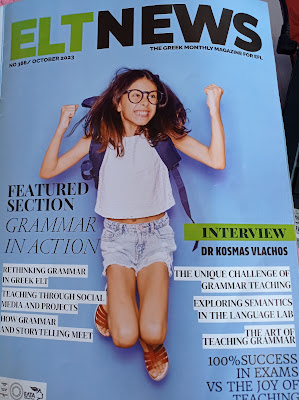
Teaching Grammar: The accuracy of calling its teaching an art

Image
  Grammar: the accuracy of calling its teaching an art Grammar learning and the implicit comprehension of language patterns Considering one of the definitions of art as “the process of making the familiar unfamiliar”, grammar teaching can justifiably be paralleled to art. Grammar estranges language, it makes it look unfamiliar. For us, teachers, it takes long and intensive training to teach grammar accurately and comprehensively, and we need to instruct grammar in a way that learners want to remain engaged.   Learners’ attitudes and responses to the scientific side of language Students respond to grammar defensively: we observe how they silently withdraw and how they reluctantly, or minimally engage to grammar activities. Grammar seems to be the point where language makes no sense. Especially English grammar. Jonathan   Rigdon (1903) voiced the complexity of English grammar early on: “he who can analyse the English sentence is well prepared to analyse anything ...

Essential Complementaries: English as an Additional Language and the New Media Language Integrating #NewMediaDiscourse-Vivifying your #EAL

Image
  Essential Complementaries: English as an Additional Language and the New Media Language Integrating #NewMediaDiscourse-Vivifying your #EAL The New Media Language The familiarization scale of new media discourse is unlimited: naturalized. The process and the outcome of naturalization reflects the degree of familiarity with what has been consciously learnt to the extreme that the notion is thought of as   natural, innate-forever existent. Readers of the new media-generated texts (audio, written and visual) are not estranged by the use of symbols, hashtags, labels and the homogeneous structure and the heavily emotional language of the news media.    English as an Additional Language The term EAL stands for the use, or the study of the English Language by non-native speakers in and English-speaking environment (Nordquist, 2020). The term is preferred as English as an Additional Language acknowledges that students are already competent speakers of at least ...

Without Words, nothing can be Conveyed

Image
  Why is vocabulary development essential in TEFL learning? Vocabulary accuracy renders human interlocution substantive. In order to obtain accuracy , one has to hold a satisfying range of lexis. It is advisable to develop eloquence, because its employment facilitates human interaction and communication. TEFL teachers  share the need for developing dense and various lexis, and therefore they rely on creating synapses based on synonyms. Yet, from a translator's perspective, synonyms do not exist. Even among tautological terms, different word choice carries a different spirit, connotation, essence, sentiment and inference.   Thus, different communicative effect Consider the case of the intended meaning of memory and the potential options (synonyms): According to Merriam-Webster dictionary (the online edition) they could convey the concept of carrying a memory by employing one of the following: anamnesis, memory, recall, recollection, reminiscence, memento, m...