Posts

Umberto Eco 一 «Noi siamo la nostra memoria. Quando morirò, ricorderò tutto»

Image
☆ As humans, when we say "I", we mean our memory  ☆ Memory is selective ☆ Shared memories mean common identity, ☆ Semantic memory is what we know about the world ☆ We are made of time ☆ Without memory, there is no soul  ☆ Fathers die when they stop telling us what they know and begin asking us something new  ☆ The day I'll day I'll remember everything

Zubi & Ashref & Anatu - Weight (Original Mix)

Image

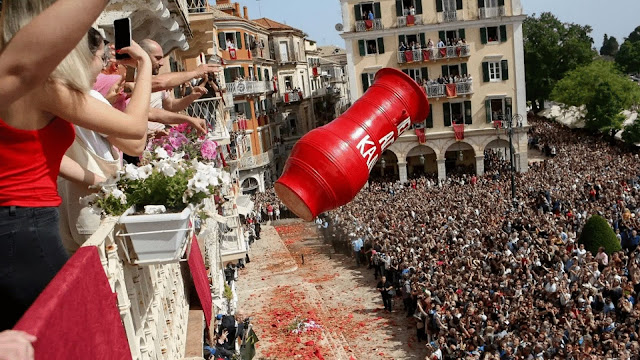
Greek Easter: Holy celebration of life over death around Greece

Image
  By Marina Siskos Orthodox Easter evokes the closest feeling to holiness. Greek Easter (Pascha) heralds the arrival of spring, hope and the atmosphere around Greece is replete with a rejuvenated sense of joy, community and of course, festivity, celebrating the eternal victory of life over death, through experiencing death itself, just as reverberated in the Resurrection hymn: “ thanato, thanaton patisas ” ( θανάτω, θάνατον πατήσας ). Originally, Easter apparently was regarded as commemorating the Crucifixion, but the interpretation was shifted quite early to the Resurrection (Barnett, 1949). The Holy Week (Megali Evdomada) or the Week of Pathoi (the series of the sufferings and sorrows, representing the days prior to Christ’s crucifixion by the Romans in 30 A.D.) is the week prior to the Holy Easter, starting from Palm Sunday (Kyriaki ton Vayon) up to the Holy Saturday. It marks the final week of Lent, the forty-day period of fasting, prayer and penitence, and of which each day is...

Remembrance Day for the Thracian Genocide: The Black Easter of 1914

Image
By Marina Siskos. April 6 marks the Remembrance Day for the genocide of Thracian people. For Thrace, Easter of 1914 was the  Black Easter. Implications of injustice, massive destruction and extermination of the Thracians extends to the present as the genocide affects the formation of identity and consciousness of their descendants. Collective memory moulds identity: mentality, discourse, self-perception and all its dimensions, material and non-material culture, literature and mythologies, directly or indirectly refer to the past and the suffering, the need for remembrance and the what should have been. Systematic atrocity: Backdrop of the Genocide of Ottoman minorities The turn of the 19th century heralds the collapse of the “multi-ethnic, multi-religious Ottoman Empire,” manifested among a host of factors, such as the weakening of its once robust army, by the emergence of national independence movements, in tandem with opposing, imperialist European powers (Hoffman, 2022). The mov...

Ash - Nomad Jam Session #5 - NYC

Image

Masculin Féminin (1966) - Jean Luc Godard (English Subtitles)

Image

Carnivalesque customs of Thrace: The timeless value of satire practiced through rituals

Image
  By: Marina Siskos Published in the Greek Herald  https://greekherald.com.au/culture/history/carnivalesque-customs-of-thrace-the-timeless-value-of-satire-practiced-through-rituals/?fbclid=IwAR383O4Bg0MzPE2Pm8_FHXAupa8cPpwKjAE8PHhNAUiAAHw3k8mFNlyKDhw Carnival customs are observed on the first Sunday of Christian Orthodox fasting, The Tyrian Sunday, alongside most significant Thracian customs Thrace is Dionysus’s birthplace. Dionysus, or Bacchus, was the god of the grape-harvesting, winemaking, vegetation and fertility. Dionysus was the son of Semeli and Zeus (Moutsopoulos, 2016). Thracian festivities celebrated to this day are sharply reminiscent of Dionysus’s characteristic shenanigans (Moutsopoulos, 2016). The customs known as  Kopek   Mpehis  and the  Monks , as described in narrative skillfulness by the master of  ethnographia , Georges Vizeynos, date back to the antiquity. Representations of the carnivalesque customs and practiced are preserved wi...